Jun 15 2026, 9.34am / Features
To Joey & Brooke, I’ve written a lot of words on this site, but none …
MORE: OCEAN GROVE: A Slight Return To Earth // NORMA JEAN: In Service Of Rock And Roll REVIEWS: THE AMITY AFFLICTION: Everyone Loves You… Once You Leave Them // OCEAN GROVE: Flip Phone Fantasy // CODE ORANGE: Underneath // VIOLENT SOHO: Everything Is A-OK // AUGUST BURNS RED: Guardians // THE CHATS: High Risk Behaviour // ALL TIME LOW: Wake Up, Sunshine
But that was exactly the task facing Swiss hard rockers Gotthard when their well-loved frontman Steve Lee died during a motorcycling holiday in the US on 5th October, 2010. A popular if not particularly well-known band outside of Europe, in their home territory Gotthard were veritable superstars, with an incredible eight consecutive #1 albums behind them. Whoever they chose to replace him was going to be faced with a truly daunting challenge.

“In Switzerland, Gotthard is the biggest rock band in the country and has been for a very long time, and Steve Lee was a huge personality,” explains the man who eventually got the job, Australian-born Nic Maeder. “So when he died, he was heavily eulogised, and whoever replaced him was going to be heavily publicised as well. I just woke up one day and I was in all the newspapers and all the TV, it was a frenzy! I don’t think I realised how big the band actually was. It was just a hard rock band, but for the first year or so I couldn’t even really walk out on the street! It was really quite heavy and overwhelming and weird.”
I’ve always thought they were diverse! And as a songwriter, it’s always been a great band to write for, because there’s a lot of freedom and we’re not just contained in that one thing and we can open the box a bit.
[ Nic Maeder ]
Maeder had been recommended for the role by mutual friend Freddy Steady, the off-again, on-again drummer for Swiss rock veterans Krokus, whose storyline has crossed Gotthard’s more than once.
“He called me and told me that Gotthard were continuing and wanted to hear me audition for them,” Maeder recalls. “And he said the same to them: he said he had a friend who was Swiss-Australian who would like to audition for them! So he kind of played us a little.”
The audition process lasted until well into 2011.
“They had about 450 other people who went for this as well, so they had to spend a lot of time in auditions and a lot of time going through stuff, and they had several people who sounded pretty identical to Steve Lee, but obviously they wanted to go with something different. I auditioned for them for about eight months before I finally got the job.”
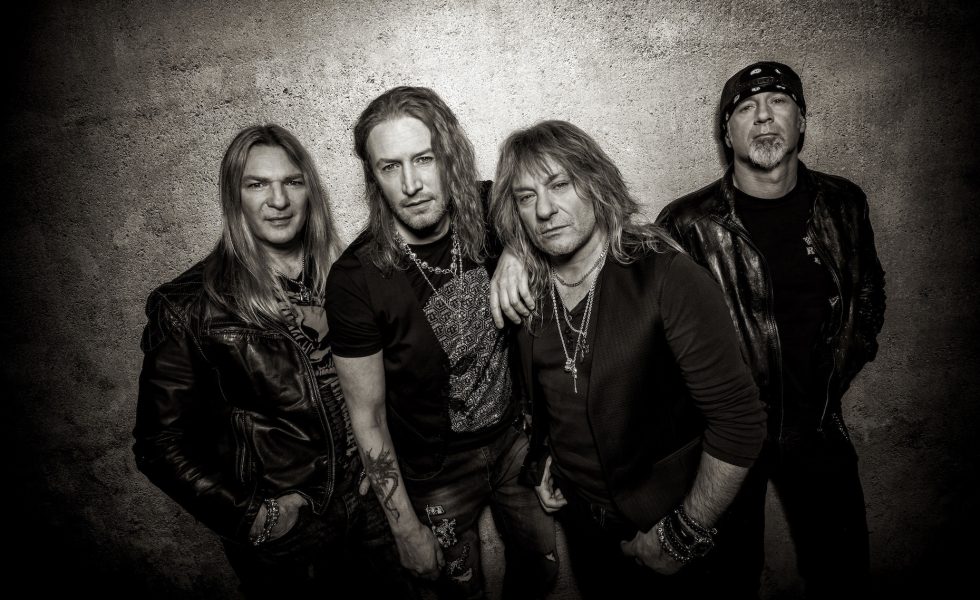
Maeder was announced as Lee’s replacement on 11th November, 2011 when the band dropped a clip for the first song they had written together, Remember It’s Me. Nine years later, Gotthard’s momentum remains remarkably undiminished—their albums have continued to hit the top of the Swiss chart and also do strongly in Germany. Most importantly for Maeder, he’s been warmly, almost lovingly, received by the band’s steadfast fanbase.
“It took a while, but I’m not the new guy anymore!” He laughs easily. “I was very, very lucky that the fans accepted me. There were times when it was really hard for me and they really encouraged me. But four albums and nine years in and we’re going really strongly now.”
I don’t think I realised how big the band actually was. It was just a hard rock band, but for the first year or so I couldn’t even really walk out on the street!
[ Nic Maeder ]
Gotthard’s latest album, #13, has received some of the best reviews of Maeder’s time with the band. Critics have been particularly focused on its diversity, something that leaves the singer somewhat perplexed.
“I’ve always thought they were diverse! And as a songwriter, it’s always been a great band to write for, because there’s a lot of freedom and we’re not just contained in that one thing and we can open the box a bit. But for some reason people think that this one is even more so than the others.”
Featuring Gotthard’s well-established Scorpions-inspired combination of hard and heavy rocking and soaring power ballads, #13 was the band’s attempt at getting back to an earlier, less-heavily produced sounding album.

“We just wanted to go back to a raw, honest-sounding album,” Maeder says. “We even talked about not having keyboards, although we did eventually have some on there because it’s part of the Gotthard sound, but we just kept it a bit more in the background as a contribution to the sound rather than an overall sound. It’s very melodic too, and I like a lot of melodies that are on this album.”
The band planned to launch the album with a live show on 13th March, but obviously the outbreak of COVID-19 scuppered their plans. Instead, they were forced to get creative and ended up doing a live stream from their rehearsal room although that, too, wasn’t the original back-up plan.
“I think we were one of the first bands to do it, because it was right at the start and we had our release party down for 13th March, Friday the 13th! They were just starting to cancel stuff in Switzerland and we weren’t allowed to do more than, I think 1000 people, so we had to cancel this thing. But we knew this radio station that had this big stage and a few cameras and we were going to stream that, but that got cancelled as well! So in the end we got a camera crew to come down to our rehearsal room and we played a bunch of songs and we did it that way.”

One of #13’s major talking points has been Gotthard’s cover of the ABBA hit S.O.S. As Europe’s biggest-selling pop band of all time, the Swedish combo’s music still has an enormous influence on popular music throughout the continent, even on Swiss hard rock bands. Like other rock acts who’ve tackled ABBA’s material, Gotthard stripped away the sugar and the disco beats to present the dark core of the song itself.
“That song, the lyrics are kind of dark and sad, but the way they did it, it sounds like a happy snappy song. We felt like we had to make it super dark.”
The idea presented itself to the band after Maeder was invited to perform it on a Christmas ABBA tribute on Swiss TV. He did a piano-and-vocal reading that impressed the rest of the band enough for them to include it on #13.
“I showed the guys, and they loved it,” the singer says. “Leo actually turned around and said that they wanted to do that song years ago with Steve. They apparently did a demo version, which we never found. We tried three or four versions before we were happy with it, but it turned out pretty well!”