Jun 15 2026, 9.34am / Features
To Joey & Brooke, I’ve written a lot of words on this site, but none …
After only a handful of years it seemed that it had found its place in the history books. By the middle of this love lethal decade, heavy had all but retreated from the charts.
MORE: Dead Of Winter Festival Drop Mammoth Second Line-Up Announcement // Underoath – Soul Remover
Judas Priest were latecomers. They came in on the tail end in ‘74 with Rocka Rolla. If the band possessed showy technical chops or a lofty intellectual idealism they didn’t show it. Theirs’ was a different noise. Plain and simple. Incendiary. Faster than a laser bullet louder than an atom bomb. All the angst of teenage wasteland, supercharged.
‘ard, ‘eavy and oh so passé. Priest’s popularity baffled critics. Yet few could argue with the numbers. Flying in the face of prevailing trends their headbanging congregation continued to grow. By the dawn of the ‘80s the Birmingham throwbacks were no longer consigned to the margins. With a flash of incendiary noise, they rode upon the forefront of a new wave of metal resurgence.
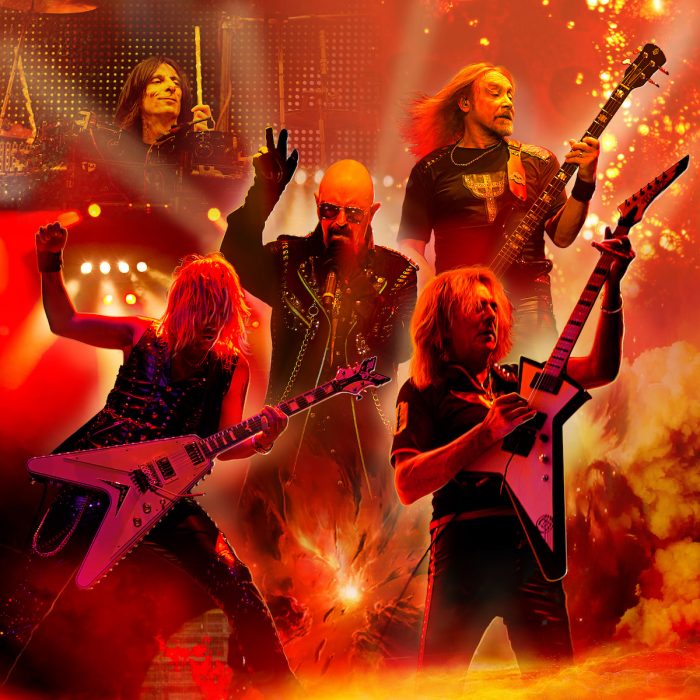
Heavy came back and Judas Priest have been here ever since. The genre ebbs, flows and contorts but the outfit endures. As latest recruit Richie Faulkner sees it they’re entering another of metal revival. With 18th album Firepower, his group are hitting career highs as surprising as they are late.
You can feel Faulkner’s excitement. His words come bolstered by the assurance that the new long-player is capturing the metal monster sparking off as aggressively and exciting as ever before. And reader? Listening to Firepower we’re inclined to agree.
Hysteria: Having joined a group in 2011 you’ve not only had the benefit of playing in Judas Priest but also experiencing their music as a fan. What was your first impression of the band?
Richie Faulkner: I remember back when I was younger than 10 hearing songs like Breaking The Law and Living After Midnight. In the mid-to-late ‘80s, those songs were very much in the public domain. I knew the songs, but I wasn’t quite sure what the name of the band was if you know what I mean.
I think it was only later on with realised such as Painkiller in my early teens, it was only then that I was aware. “Oh, this is the same band that produced those songs earlier on in my childhood!” That was when I really became aware of Judas Priest.
Later I became a guitar player in bars and clubs. Judas Priest was the staple of the gigging rock guitar player! Along with Sabbath, Iron Maiden, Deep Purple, UFO and that sort of stuff. So I was, by then, intimately familiar with Judas Priest in a playing sense and obviously, they’ve been a big part of my life ever since I’ve joined the band.
H: Moving forward in time a little, your tenure with the group has coincided with the view of many fans and critics that the band is hitting a late-blooming career high. I’m not saying it doesn’t happen with other groups, but it’s a rare thing. Do you think you can take a little credit here?
RF: I don’t think so, no more than a football team changes when it changes players. There’s always going to be a different dynamic, but I think as you’ve just said there, the fact that after 50 years the band’s still putting out music is a testament to the rest of them really. I don’t think you could do something for almost 50 years without having passion and a dedication to do it.
And also, it’s about the fans! The fans have been there since day one or there’s new fans that’ve come in. They’re buying the music to the point where it’s getting it in the charts. We can only create it and put it out there—do what we think is a great album–but it’s up to the fan! They vote with their dollars of their cents or their pounds or whatever it is and put it up into the chart position.
It’s a thank you to them really. Just an affirmation to how strong heavy metal still is and how much people love Priest. So we can only thank all those fans around the world for that.
Well there’s always a rebellious side to rock ‘n’ roll and there always has been. That’s the nature of it. Whether it comes from the band itself or the interpretation of the message in the music.
[ Richie Faulkner ]
H: Being an artist who’s been part of the world of metal for such a long time did you ever think it would ever penetrate the popular conscious the way it has? It’s come a long way from a movement labelled as ‘obscene’, ‘subversive’ and ‘the Devil’s music’. It’s a household genre, part of the fabric of popular music…
RF: Well there’s always a rebellious side to rock ‘n’ roll and there always has been. That’s the nature of it. Whether it comes from the band itself or the interpretation of the message in the music. As you’ve said with the obscenity thing which Judas Priest was very much in the middle of all those years, people were interpreting metal or perceiving it in a way that it wasn’t meant to be perceived!
On the other hand, you do get people in rock and in metal that do have a message and the music is rebellious sounding. It kind of goes hand in hand with rock and metal. I think it just takes people a while sometimes to understand that message.
But it’s a positive one, especially in Judas Priest’s case. We do have some social struggle messages but it’s always from a positive point of view. It’s always about standing up for yourself and overcoming those challenges.
I think sometimes those messages get blurred, so you get a bit of pushback and it might fall out of favour for a little while and then come back later on. But as you rightly said, metal seems to be facing a new era in popularity, it’s undeniable! There’s metal everywhere. We’re in the mainstream charts so long may that continue I say!
H: Let’s talk Firepower. High profile recordists tend to leave their own distinctive fingerprints on the albums they produce. With this new album you’ve worked with not one but two! There’s these extra personalities in there in addition to the band. How did you go about creating a unified album?
RF: It’s an interesting question. We had no idea it would work as well as it did really. Again, you’re absolutely right there could have been some clashes there! There could have been some ego clashes or differences of direction from the producers.
But the band have worked with Tom Allon since 1979 when they released Unleashed in the East and right up until Ram It Down. He’s also been mixing, putting together and recording some of our latest live stuff too. In 2000, 2012 and 2015 we’ve had live releases.
Tom’s intimately involved with Priest. The band know him and trust him. He’s had a great track record with the band.
And the other, Andy Sneap, is a Priest fan! He’s a great producer. A bit of a more modern producer. He knows Priest and he respects Priest.
They’re both great guys and got on really well. Stylistically they were on the same page. They had the same ideas and they both contributed to their own vocabulary when it came to recording techniques. Tom maybe helped Andy out and introduced him to some new techniques and vice versa.
They got on like a house on fire. It was just a great environment for us and for them to get the best out of us. It was just a fantastic team on all those fronts.
H: I’ve been talking to a few metal bands over the last year or so and it seems that the more live approach to recording, the band in the room playing sort of thing, is really falling back into favour. Why do you think that is?
RF: Well I think obviously with the development of technology the advancements–me and you could put an album together in our living room if we wanted. You know that’s a great thing, it’s enabled a lot of people to really express themselves, put ideas down and create. But on the flip side of that I think that, because it’s easier to do, it’s taken away the communal aspect of recording.
Getting the guys and girls in a room and getting that push and pull. It’s the way music naturally is, it’s got troths and it moves around and you get inspired by the other people playing and you bounce ideas off of them. It’s almost like a subliminal thing, you’re communicating with each other while you’re playing the music. If someone does something spontaneous or exciting you respond to that.
I think that’s why this has happened. We’re seeing more and more of that again and I think it’s a good thing. I think most of the classic albums that we know and we love– hat we’ve grown up with–were recorded like that. There’s something subliminal about the way music sounds when it’s created like that. It’s very natural, very organic, and the energy is something which is very spontaneous.
I for one would like to keep making music like that! But then I can see the advantages of putting stuff down. If you don’t have the option to get in a big studio with a group of people or you don’t have a band. I’m not undermining that in any way shape or form.
H: You’re touring the new album too. How are things going on the live side of things?
RF: We’re feeling great about it! We’re a few weeks into the North American leg of The Firepower Tour. We’ve got a great setlist, we’ve got some songs from Firepower and we’re looking at putting more and more songs into the set from the album as the tour progresses.
You’ve got to be careful though. You can’t put too many songs in to begin with you’ll alienate a few people you know! But as the album gains more traction and as more and more people listen to it we’re looking forward to putting more song into the setlist. But also, some more classics as well.
We’re going all over the planet. Europe, South American, Asia and Australia too. We’re looking to give some people a different experience, so we’ve played one setlist in America, then another in Europe and we’ll change it slightly when we’re going somewhere else. It keeps it new, it keeps it exciting and keeps putting some new firepower into the set.
H: Is there a song, from the new album or the classic repertoire that’s really getting the crowds going? Something you might not have expected?
RF: Well there’s a couple of surprises and a couple of non-surprises really. We’ve put a few songs like Bloodstone and Some Heads Are Gonna Roll into the set and for me as a Judas Priest fan that was no surprise. I think it’s been a while since either of those songs have been played live. You Don’t Have To Be Old To Be Wise is another one, it’s never been played live before this tour.
It’s great and the thing is with the new ones mate, you never know how well or how not so well they’re going to go down! But Firepower this song is a rip-roaring track, it’s a great opening track. Evil Never Dies is great and we’re doing Lightning Strike as well.
The surprise is getting those new songs and connecting them with people in different ways. The more we act out the set the more of those surprises we’re going to have. We’re looking forward to that.