


Jun 15 2026, 9.34am / Features
To Joey & Brooke, I’ve written a lot of words on this site, but none …
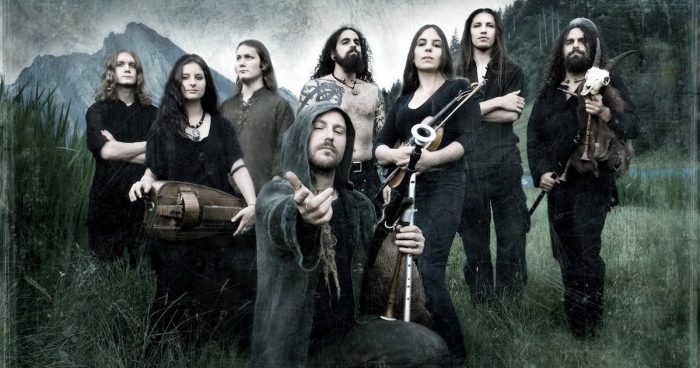
A what? A hurdy-gurdy is a hand-cranked string instrument that you probably hadn’t heard of (and we don’t blame you.) It’s part of Eluveitie’s distinct sound, especially when unplugged as new album Pantheon forms part two of their Evocation concept. Recreating the music of ancient Celtic Gaulia (modern day France), bandleader Glanzmann had to find replacements for three departing bandmembers last year; a hurdy-gurdy player among them. Nope; it’s not exactly something you conjure up with synths. But apparently in downtown Zurich, finding musos who play arcane instruments isn’t that big a deal…
Hysteria: Evocation is part of a two-album concept, or cycle. Tell us a little bit about that.
Chrigel: I wrote the Evocation concept back in 2008, it just kind of happened to become a two album thing, it was written and meant to become a two album cycle. Yeah, basically, Pantheon now is literally just the sequel of our two … it’s the logical consequence after part one.
Musically, it just really continues the concept of part one, and also conceptually the idea behind the whole Evocation concept was to take original and pristine Celtic mythology and put it into music somehow. And there was also the full albums in Gaulish language. And while the first part took original Celtic texts of magical nature, which means texts that have been written down roughly around two thousand years ago and have been found in archaeological excavations, as song lyrics.
Part two now kind of takes it back to where it all comes from, in the Celtic understanding, which would be the other world. This world beyond in a Celtic understanding where we all come from, and where we all go to at some point and where all the gods live. You look at the album as a journey through that world, a journey through the Celtic pantheon, and each track being dedicated to one Celtic deity.

What’s fascinating is the depth of research you seem to do. I don’t know if this is just your thing and you think, “Research? I didn’t research, I just like it.”
The passion comes from…well, I really don’t know. This has been a topic in my life for forever, somehow. But yeah, as it comes to Eluveitie, you’re right, actually, there’s quite a lot of work in this field. One thing that we do is that we kind of work scientifically. Each Eluveitie album is somehow also a little bit like a scientific project. Actually, from day one we always work together with scientists. As it is, when you work together you get to know each other, and you become friends.
One scientist knows another one that is probably specialised in this particular question you have. Today, after fifteen years, something like a very friendship-based network of scientists from universities from all over Europe working together it becomes to create a new Eluveitie album. And yeah, that’s basically what we do, and how it works. There’s a lot of researchers especially when it comes to things like mythology. because that’s a rather difficult topic because you don’t know that much, or there aren’t that much firsthand informations on that. Because Celtic didn’t write these things down. It’s all based on the current state of knowledge of science.
You guys lost three of your members last year. Eluveitie is this huge band. Tell us a little bit about that. It’s not like every day you can put up an ad saying “I’m looking for a Hurdy-Gurdy player” and 1500 people come out of the woodwork.
Yeah, it depends probably. It depends where you live. Finding a new Hurdy-Gurdy player is not more of a challenge than finding any drummer or something like that.
We’ve always been a rather big band, and early last year we had three members leaving the band, and we replaced those three members, and we have one additional member, now. So it’s that way around. But to us, it was something like a back to the roots kind of thing. Because, you know, back in the day when we created our debut album we actually been a nonet, we’d been nine people, and we wanted to go back there. So, we’re nine again, instead of eight.
The energy that comes out of [Celtic] music is actually quite comparable to the energy of metal. That’s what I always felt.
[CHRIGEL]
You play so many instruments yourself; mandolin, whistles, bagpipes, guitar. It seems bizarre to someone in Australia seeing all these instruments and things coming out. And we think “Wow, these are so wild!” But it would seem quite normal to you guys.
Actually it kind of is. I think the didgeridoo or something is something pretty common in Australia if I’m not mistaken, and it’s maybe a little bit like that. Traditional folk music is quite big over here in Western Europe. The instruments we have in our lineup are just the most common instruments used in traditional Celtic folk music.
Actually it kind of is. It’s probably like whatever. I think the didgeridoo or something is something pretty common in Australia if I’m not mistaken, and it’s maybe a little bit like that. Traditional folk music is quite big over here in Western Europe. The instruments we have in our lineup are just the most common instruments used in traditional Celtic folk music.
Another thing that sort of strikes me is obviously there’s a lot of folk metal and crossover stuff like that. It seems to me that metal just sort of works with folk music.
I formed my first death metal band back in 1991. I also started playing traditional Celtic folk music myself quite many years ago. And that’s always something that kind of struck me. When I’m attending sessions in Ireland and sort of stuff like that, that’s basically the way traditional Celtic music is played. It usually spontaneously in pubs and bars and stuff like that. And the energy that comes out of this music is actually quite comparable to the energy of metal. That’s what I always felt. And also, on a musical level, if you look at the left hand of a guitar player in a melodic death metal band and compare it to the left hand of a mandala player in a traditional Celtic folk band, you will actually find out what they do is rather similar. So that’s actually what originally brought me to create a band like this. Because I always had a feeling that both would actually go very well together.
Read our review of Pantheon here!
